
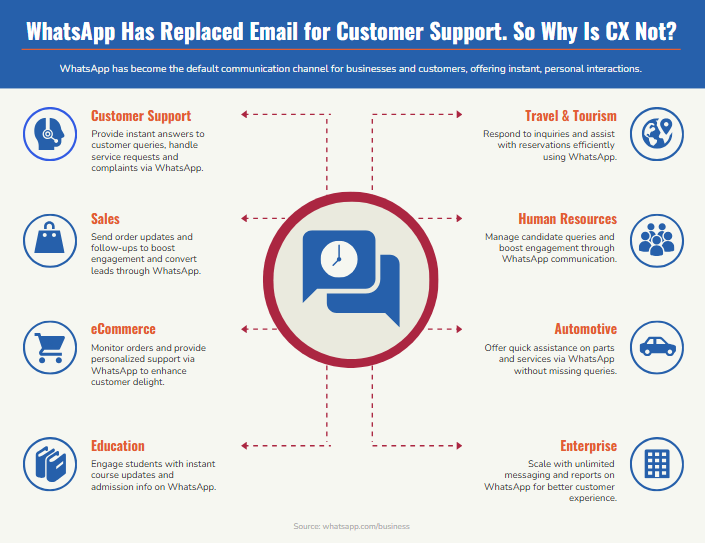
Over the last few years, WhatsApp has quietly become the default communication channel between businesses and customers. From order updates and service requests to complaints and follow-ups, customers increasingly expect businesses to be reachable on WhatsApp.
For customers, WhatsApp feels instant, personal, and convenient.
For businesses, it offers high engagement and faster response rates compared to email or call centers.
But there’s a critical question most organizations don’t stop to ask:
Are we actually tracking and learning from WhatsApp interactions – or just responding to them?
WhatsApp Is Everywhere, But Visibility Is Not
Most businesses today use WhatsApp in one of these ways:
- Messages handled on individual phones
- Shared access via WhatsApp Web
- A WhatsApp Business account responding reactively
In all these cases, conversations happen – but data does not accumulate.
Messages are answered, problems are solved (sometimes), and the chat scrolls on.
But once the conversation ends, there is often no record, no categorization, and no insight retained.
As a result:
- Businesses don’t know how many queries they handled
- Teams don’t know which issues repeat most often
- Leaders don’t know what drives customer dissatisfaction
WhatsApp becomes a firefighting tool, not a learning channel.
Responding Is Not the Same as Managing Customer Experience
Many organizations believe fast replies equal good CX.
Speed matters, but CX improvement requires patterns, not just reactions.
If a business cannot answer questions like:
- What are customers asking us most frequently?
- How often do customers follow up for the same issue?
- Which queries consume the most effort?
- Where do delays or escalations happen?
Then WhatsApp, despite high usage, is not improving CX – it’s only increasing workload.
The Missing Layer: Process
The problem is not WhatsApp itself.
The problem is the absence of a simple tracking and review process.
Customer experience improves when conversations turn into operational insight.
This does not require a complex helpdesk or expensive tools.
It requires discipline and structure.
Snippets: How to Turn WhatsApp Conversations Into CX Improvement
Below are a few practical principles that ensure WhatsApp interactions actually help improve customer experience.
Treat WhatsApp as an input channel, not a system of record
WhatsApp should capture conversations, but tracking should happen elsewhere – even a simple log or internal system.
Track issues, not messages
Five messages about delivery are one issue, not five separate interactions.
Tracking issues avoids noise and reveals real CX problems.
Categorize every query
Using a small set of categories (order status, delivery, billing, returns, etc.) allows teams to identify recurring friction points quickly.
Assign ownership and status
Every customer query should have:
- One owner
- One status (new, in progress, closed)
This prevents dropped conversations and delayed resolutions.
Review WhatsApp interactions weekly
CX improves when teams regularly review:
- Top recurring issues
- Oldest unresolved queries
- Repeat customer follow-ups
Most improvements come from these reviews, not new tools.
Look for prevention, not just resolution
If the same WhatsApp question appears every week, the real issue is upstream – unclear communication, broken processes, or missing proactive updates.
Fixing those reduces future messages and improves CX sustainably.
WhatsApp Is Already Your CX Goldmine
Most businesses already have thousands of customer interactions flowing through WhatsApp every month.
The opportunity is not to add more channels or faster replies.
The opportunity is to capture, structure, and learn from what customers are already telling you.
Organizations that do this:
- Reduce support workload
- Improve response consistency
- Prevent repeat issues
- Build better customer journeys
Those that don’t will continue to respond faster – but learn nothing.

